Embedded Finance for HRMS: How HR Software Becomes a Financial Platform
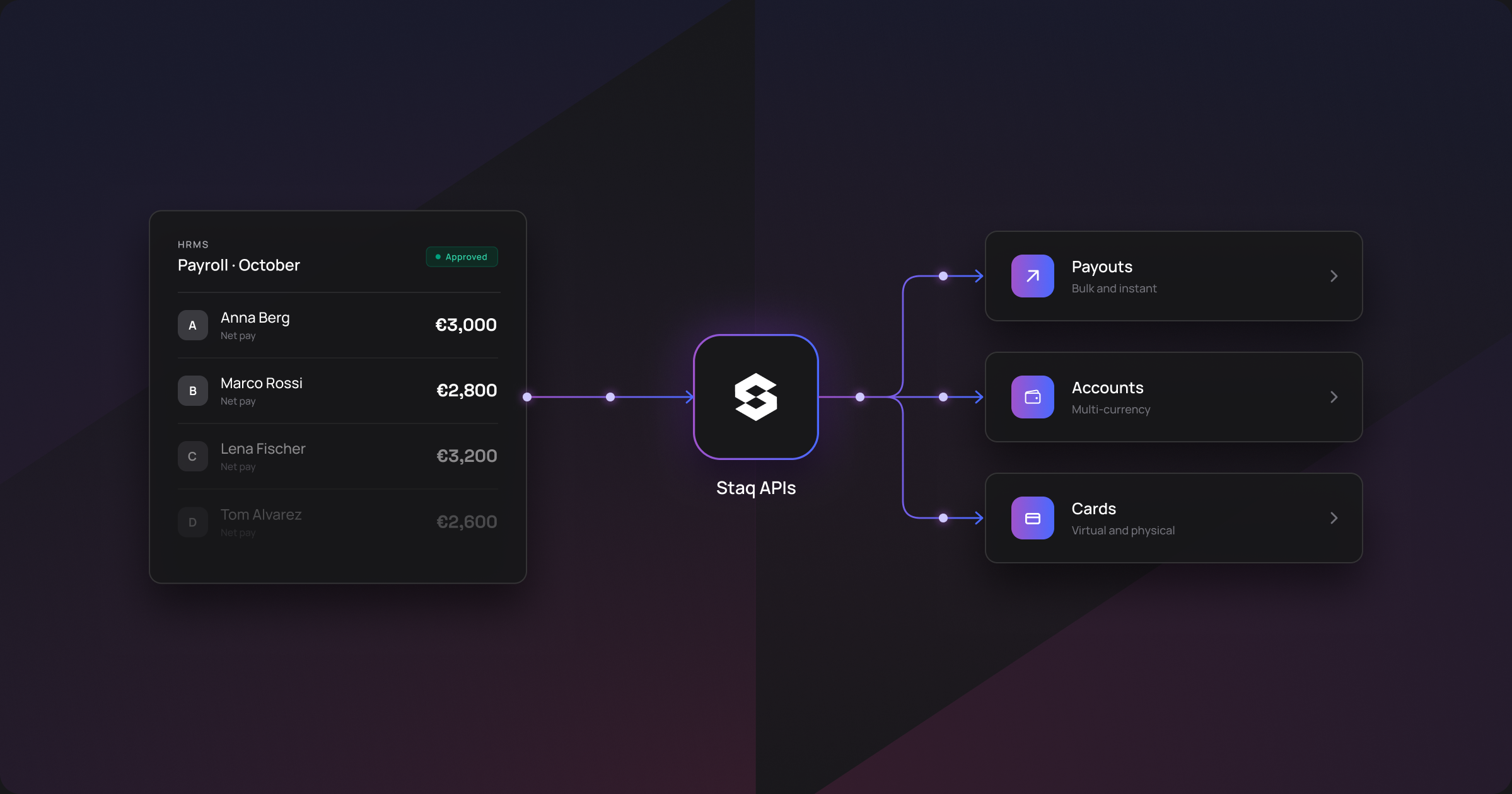
Most Human Resources Management System (HRMS) platforms are built to record things. Contracts, attendance, leave balances and salary details all sit in one place. Then, once a month, someone exports a file and takes it to a bank portal, where the money actually moves.
That handoff is the opportunity. Banking-as-a-Service (BaaS) and embedded finance let an HRMS offer payouts, accounts, cards, wage access and credit inside the product that employees and HR teams already use every day. The HRMS stops being a filing solution and becomes the place where people are paid, supported and retained.
This guide covers how that works, what it means for admins and employees, and why the data already inside your HRMS is your biggest advantage.
What Is Embedded Finance for an HRMS?
Embedded finance means delivering financial services inside software that is not a bank. BaaS is the infrastructure behind it. Regulated banking partners expose accounts, payments, cards and lending through APIs, so a software company can offer them without becoming a bank.
For an HRMS, this means salary payouts, employee accounts, cards and credit appear as native features of your product. You keep the interface, the brand and the customer relationship. The licensed financial machinery runs underneath.
Why an HRMS Is the Ideal Place for Embedded Finance
Think about what your HRMS already knows. It holds contracted salary, hours worked, approved overtime, leave balances, tenure, performance outcomes and expense claims. Every one of these is a financial signal.
Hours worked become an earned balance. A performance milestone becomes a bonus trigger. An approved expense becomes a payment instruction. Tenure and salary history become inputs to an affordability decision.
The commercial case is just as strong. A traditional HRMS earns a per-seat subscription. A platform that moves money also earns from transaction volume, card spend and credit origination, and it becomes much harder to replace, because switching now means migrating the money flows as well as the data.
1. Salary Bulk Payouts Directly from Your HRMS
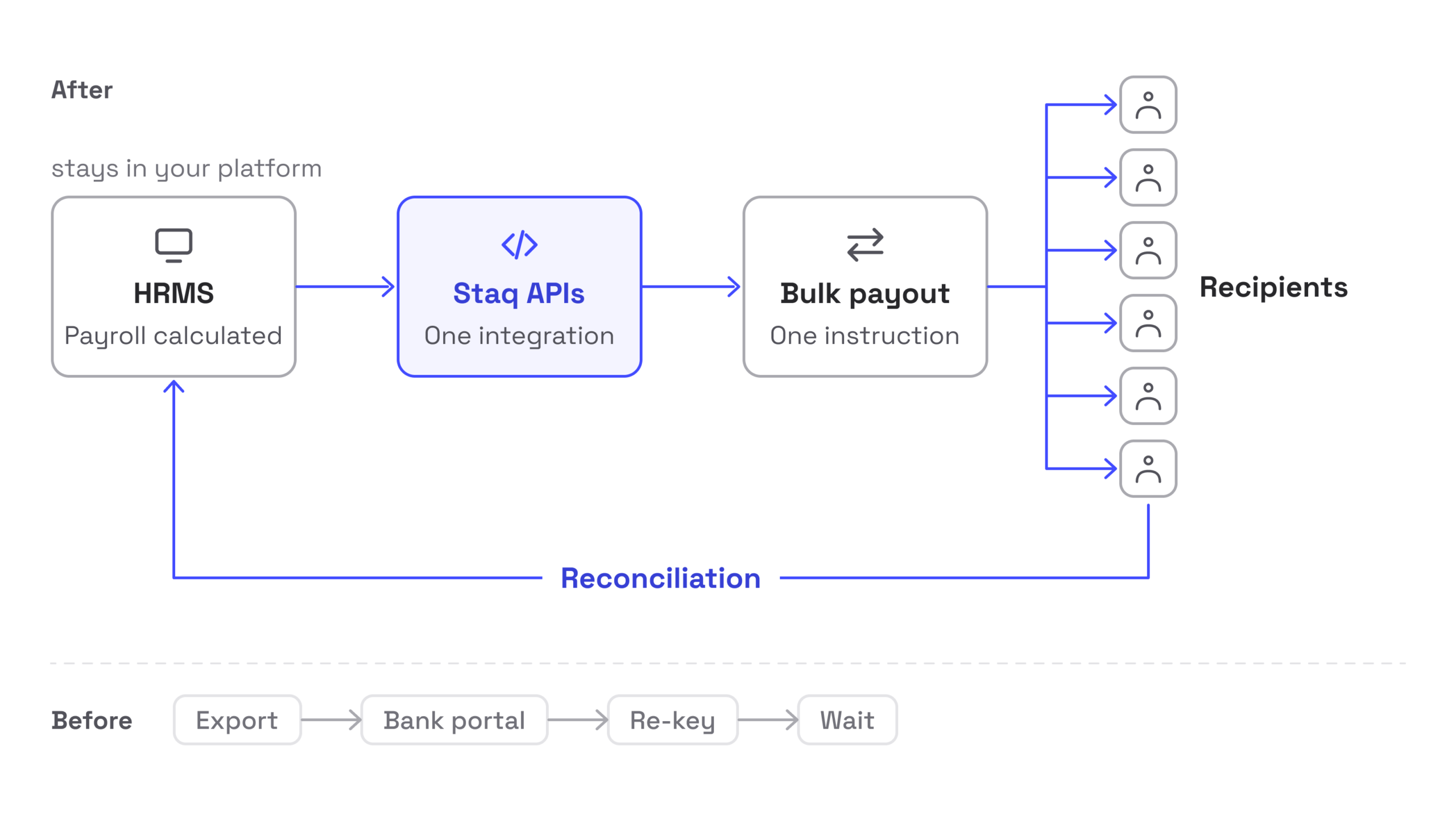
Payroll is, at its core, a batch of transfers. Yet most teams treat it as a multi-week project because the final step happens outside the HRMS: export a file, log in to a bank portal, re-enter beneficiary details, wait.
With a payments API, your payroll calculation stays exactly where it is. What changes is the last mile. The HRMS submits the entire run as a bulk payout, and reconciliation happens in the same flow instead of a week later. Scheduled runs handle the regular monthly cycle, while off-cycle payments such as bonuses and reimbursements can be sent on demand.
How Admin Controls Work
Control is what makes this safe, and it can be configured to match each customer's risk appetite. There are two common models:
- Approval through business banking. The HRMS prepares and submits the payroll batch, which then lands in the employer's business banking environment. The CFO or other authorised signatories give final approval there. This suits larger organisations that require strict segregation of duties.
- Direct execution from the HRMS. The batch is approved inside the HRMS through a configured workflow and released immediately. This suits teams that want speed, backed by role-based permissions, approval limits, multi-factor authentication and full audit trails.
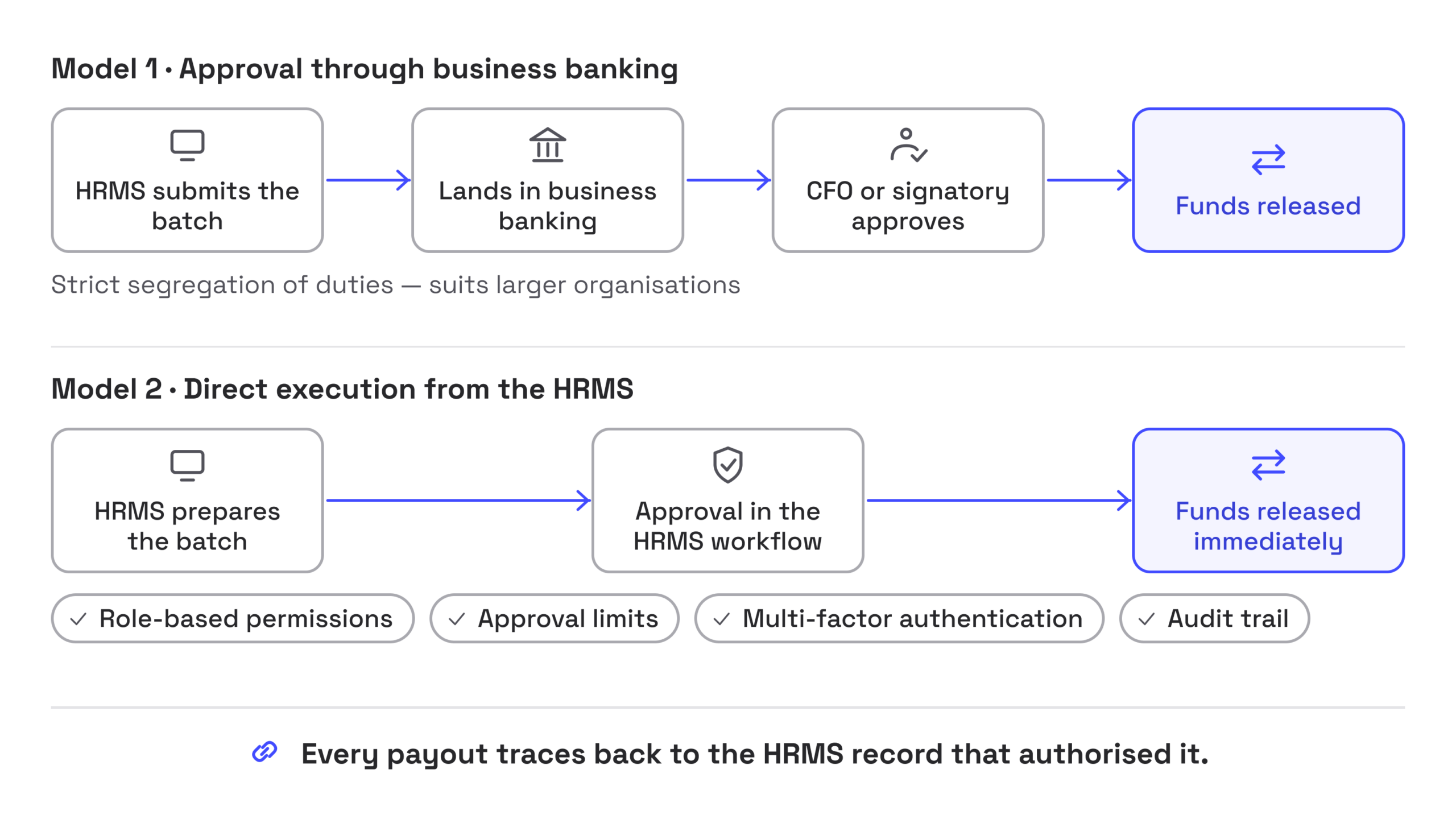
Which model fits depends on the customer's use case and security policy. Many platforms offer both and let each employer choose. Either way, every payout traces back to the HRMS record that authorised it.
2. Accounts, Cobranded Cards, Credit Cards and Loans for Employees
Once payouts are in place, the next step is giving employees a financial home inside the platform.
Opening a bank account. During onboarding, an employee can open an account through a verified digital flow, using identity document and biometric checks. Salary lands in that account on payday, and the employee sees their balance in the same app where they check their payslip. For employees without an existing bank account, this is often the fastest way to get one.
Cobranded cards. Employees can be issued physical or virtual cards carrying your brand alongside a partner bank. Spending limits, merchant category controls and instant activation or suspension give employers precise control. The same card programme can power corporate cards, per-diem cards and benefit cards, with spending rules enforced at the moment of authorisation instead of discovered at month-end.
Credit cards and loans. Employees can apply for a credit card or a personal loan without leaving the HRMS. With the employee's consent, verified employment details are shared with the lending partner, so the application is pre-filled and the decision is faster. The regulated partner makes the credit decision. Your platform provides the experience and the trusted data. Repayment schedules can also be aligned to the pay cycle, which is one of the strongest drivers of on-time repayment.
3. Embedding Early Wage Access in Your HRMS
Early wage access (EWA), also called on-demand pay, lets employees draw part of the wages they have already earned before payday. If someone has worked twelve days of a thirty-day cycle, the value of that work already exists. EWA closes the gap between earning it and being able to use it.
An HRMS is the natural home for this feature, because it holds the live attendance data that makes it safe. The roles are clearly divided:
- Your HRMS tracks hours or days accrued, calculates the available amount, applies the ceiling the employer sets, and nets the drawn amount off at payroll.
- The infrastructure layer handles the funded account, the real-time transfer to the employee and the reconciliation.
The impact on retention is meaningful. A Harvard Business School working paper by Murillo, Vallée and Yu found that employees using earned wage access were roughly 10% less likely to leave than non-users, with the effect strongest among lower-ranked staff. Withdrawals were modest and clustered late in the pay cycle, which points to people bridging a timing gap, not overspending.
One note on design: the regulatory treatment of on-demand pay varies depending on who funds the advance, whether fees apply and where recourse sits. The programme structure should be agreed with the banking partner and legal counsel before launch.
Your HRMS Data Is the Advantage, and Security Is Built In
Most fintech products start by guessing who a customer is and what they can afford. An HRMS starts with verified facts: confirmed employment, salary, tenure and attendance. That lets you offer pre-qualified products, faster approvals and limits that reflect real earnings.
This only works if security is treated as a core design principle. Embedded finance on an HRMS should include:
- Consent-based data sharing. Employee data is used for a financial product only when the employee agrees.
- Identity verification. Document and biometric checks confirm who is opening an account.
- Role-based access and approvals. Only authorised people can create, approve or release payments.
- Encryption and audit trails. Data and documents are protected, and every transaction links back to the HR event that triggered it.
- Regulated partners. Funds are held and moved through licensed banking partners operating under established compliance frameworks.
The result is a system where money moves only when a verified HR event says it should. For finance directors, this audit trail is often the argument that closes the deal.
What This Means for Your HRMS Business
- Higher engagement. Employees open the app for their money, not only for leave requests, so usage goes from monthly to daily.
- Stronger retention for your customers. Access to earned wages and fair credit reduces financial stress and turnover.
- Less admin work. Payroll preparation, expense chasing and reconciliation shrink when systems are no longer separate.
- New revenue lines. Interchange, transaction margin and lending economics sit alongside your subscription revenue.
- A stickier product. Once payroll, accounts and cards run through your platform, you become core infrastructure.
Why Build with Staq
Building accounts, payment rails, card issuing, identity verification and lending in-house would take licences, capital, compliance teams and years of roadmap. That is not what an HRMS company should spend its time on.
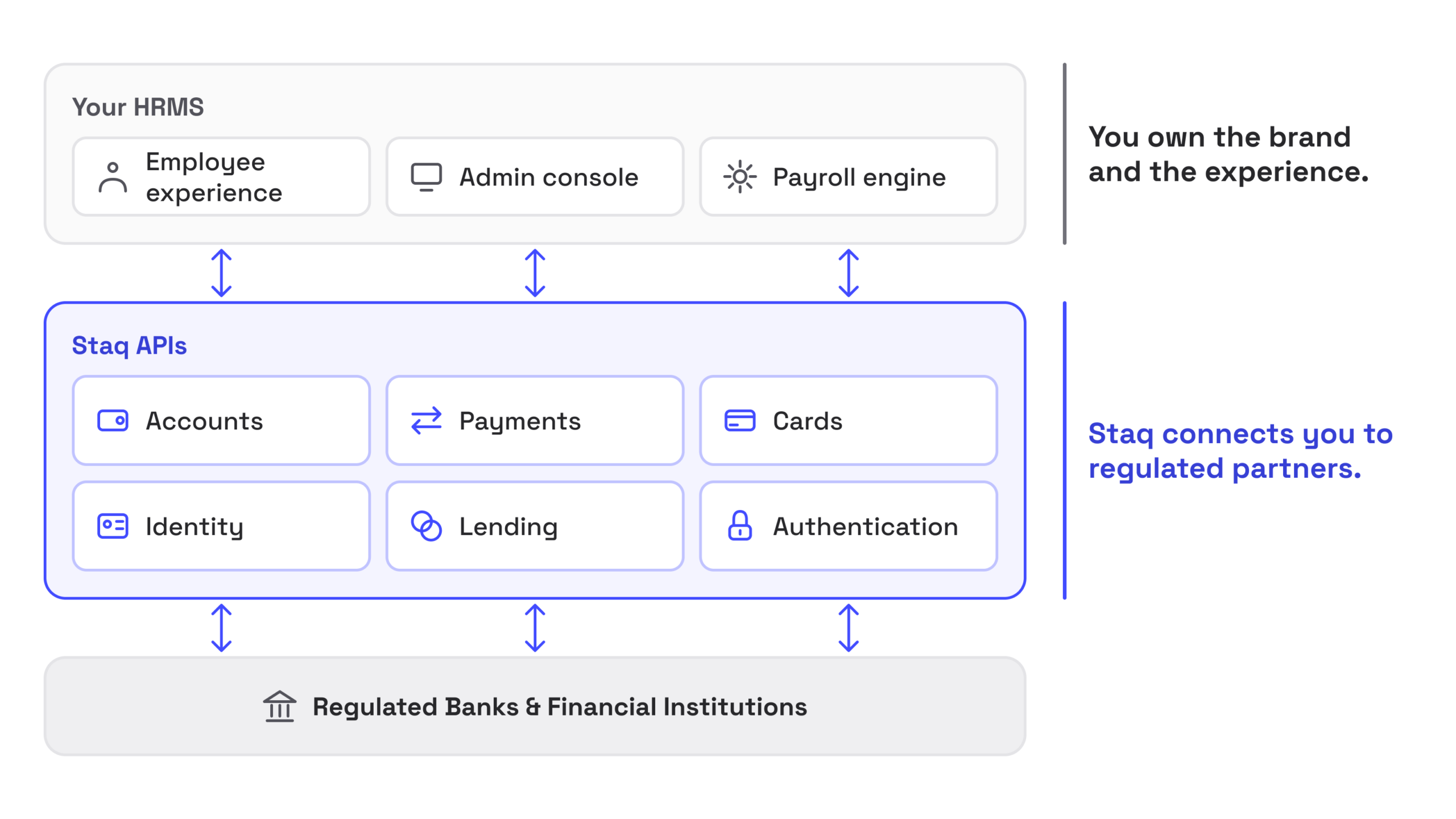
Staq's platform is a composable, API-first financial infrastructure stack. You pick the building blocks you need, such as Accounts, Payments, Cards, Identity, Lending and Authentication, and launch them under your own brand. Staq connects your systems with regulated banks and financial institutions. You do not need to replace your payroll engine. Embedded finance layers on top of what you already run.
Frequently Asked Questions
What is embedded finance for an HRMS?
It is the integration of financial services such as payouts, accounts, cards, wage access and credit directly into Human Resources Management System software through BaaS APIs.
Do we need to replace our payroll engine?
No. Your calculation logic stays in your platform. Staq connects through APIs to handle the payment, account and card layers.
Does the HRMS need a banking licence?
No. Regulated banking partners and Staq's compliance frameworks sit behind the programme. The exact structure is defined during implementation.
Can the CFO still approve payroll?
Yes. Payouts can be routed to business banking for final approval, or released directly from the HRMS under configured controls.
Ready to Embed Finance in Your HRMS?
If you run an HRMS and want to offer salary payouts, employee accounts, cobranded cards, early wage access and credit under your own brand, the Staq team can show you how. Book a conversation with Staq at hello@staq.io and let's map out what your platform could do.